
Relationship Issues Therapy
Relationships are so central to our lives and yet so often complicated, hurtful and confusing.
So when a relationship becomes the source of the pain instead: a partner you can't seem to get through to, a friendship that quietly soured, a pattern with family that never seems to change. It can feel disorienting, even shameful, in a way that other kinds of stress don't. This is what we look at in relationship issues therapy.
No relationship happens in a vacuum. The way you read a partner's silence, the speed at which you either chase closeness or pull away from it, what you assume will happen if you ask for too much. These reactions were built somewhere, usually long before the relationship in front of you. They rarely feel like reactions from the inside. They feel like the truth of who the other person is, or the truth of what you deserve.
Enough of repeating the same story again and again?
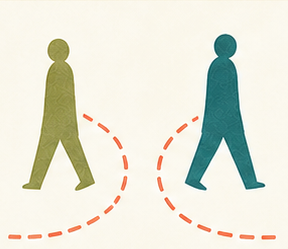
You might find yourself drawn to the same kind of person, or the same kind of conflict, over and over, even when you can see the pattern clearly from the outside. Or you might be in a relationship that looks fine on paper and still feel a persistent, hard-to-name loneliness inside it. Both are common, and neither means something is broken in you. It usually means an old pattern is still doing the work it was built to do, just in a context where it no longer fits.


You might ask yourself…
‘‘Why do I keep ending up in the same kind of relationship, even when I try to choose differently?’’
‘‘Why is it so hard for me to trust someone, even when they haven't given me a reason not to?’’
“Why do I go quiet, or disappear a little, whenever things get tense?”
“Am I asking for too much, or not asking for enough?”
These questions aren't a sign that something is wrong with you. They're usually the first sign that a pattern is ready to be looked at directly, rather than lived out on repeat.
Most relational patterns were never chosen consciously. They were learned early, often in the family you grew up in, as ways of staying safe, staying loved, or staying out of conflict. What worked then can quietly work against you now: the same vigilance that once protected you from an unpredictable parent might now read a partner's bad mood as a threat; the same instinct to keep the peace might now mean you go years without saying what you actually need.
Psychotherapy gives you the space to look at these patterns without the urgency of the relationship itself pulling you back into them. It's a place to slow down and ask what's actually happening between you and someone else, versus what old material is being replayed through them. From there, it becomes possible to respond to the relationship in front of you, rather than to the one the pattern is expecting.
How Psychotherapy
Can Help
A space where you can take the necessary distance to identify your relational patterns.

How I work
I work relationally
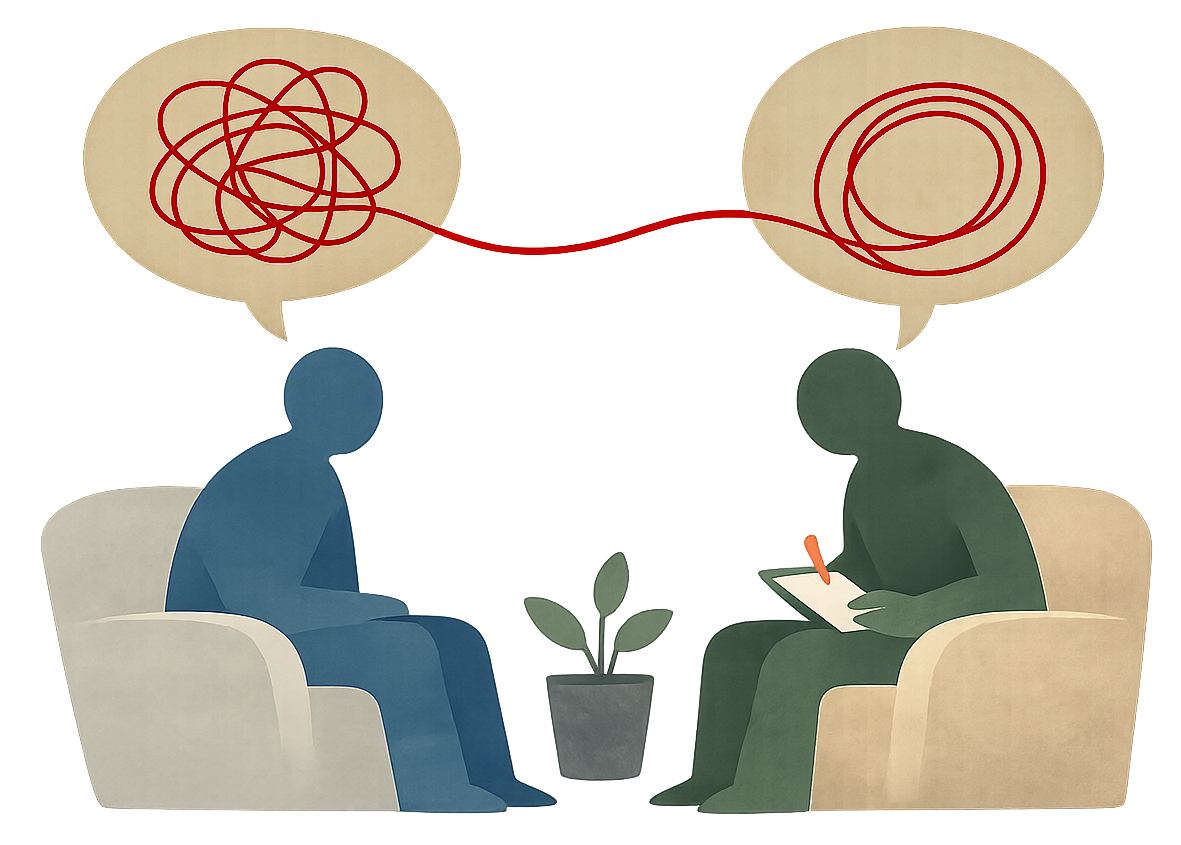
Which means the relationship between us in the room often becomes useful material in itself. How you trust, how you handle conflict, how you ask for what you need, or don't, tends to show up here too, in real time, which gives us something concrete to work with rather than only talking about it in the abstract.
Together, we trace where your relational patterns come from, what they were originally protecting, and where they've stopped serving you. The aim isn't to hand you a script for the "right" way to communicate or set boundaries. It's to help you understand your own patterns clearly enough that you can choose, rather than default, how you show up in the relationships that matter to you.